
40 Training Feedback Survey Questions (+ 4 Templates)
40 training feedback survey questions for before, right after and weeks after a session, four short templates, and how to turn answers into better training.

13 minutes
Table of contents
Training feedback survey questions
Most training gets judged by the feedback form handed out in the last five minutes. People are tired, half of them are already reading Slack, and the questions ask them to rate the room temperature and the trainer's slides on a scale of one to five. The scores come back high, everyone is pleased, and nobody learns whether the training made any difference to the work.
A better training feedback survey asks fewer questions and better ones. It finds out whether the session was relevant to the job people actually do, whether it went at the right pace, and what they plan to try first. Then, a few weeks later, it asks whether they tried it.
Below are 40 training feedback survey questions, grouped by when and why to ask them, four short templates you can copy, and advice on getting honest answers and doing something useful with them.
Three moments to ask for training feedback
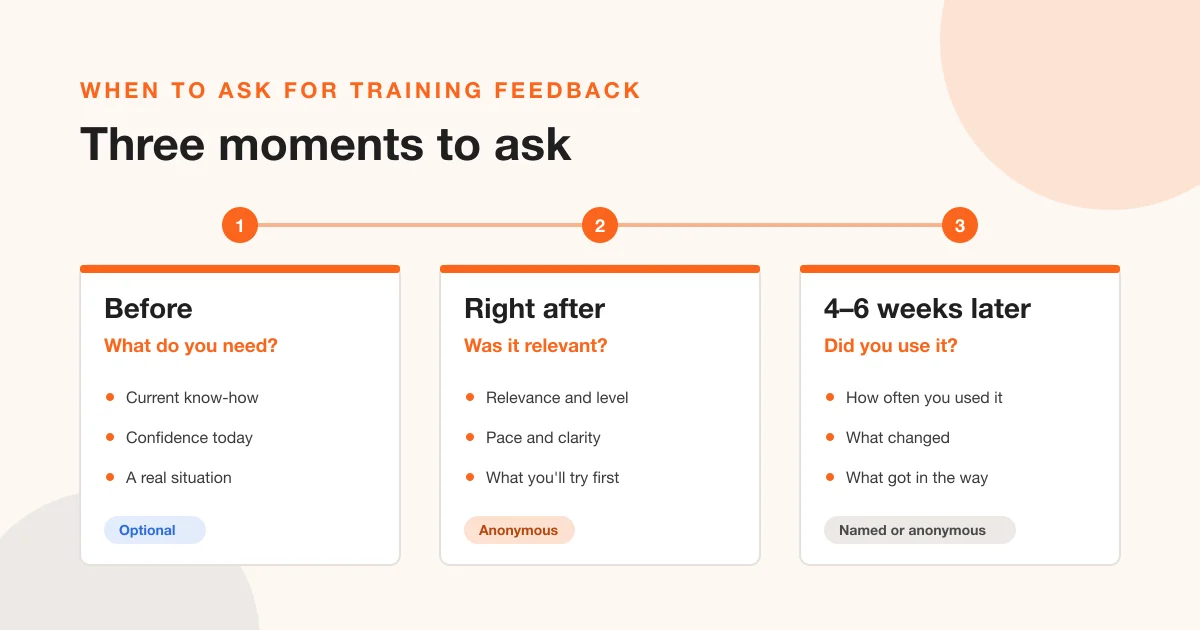
Training feedback is often treated as one survey at the end of a session. It works better as up to three short ones, each asking what people can answer well at that moment.
- Before the session: what people already know, what they hope to get out of it, and what would make it a waste of their time. This one is optional and most useful for longer courses.
- At the end of the session: relevance, pace, clarity and confidence. People remember the details, so this is the time to ask about the trainer, the exercises and the materials.
- Four to six weeks later: whether they have used what they learned, and what got in the way. This is the survey that's easiest to forget, and the one that tells you whether the training was worth the time.
This rhythm roughly follows the Kirkpatrick Model, the four-level framework many learning teams use to evaluate training: reaction, learning, behavior and results. Kirkpatrick Partners describe the first level as how favorable, engaging and relevant people find the training, and they single out relevance as the part that matters most. The end-of-session survey covers reaction and, roughly, learning. The follow-up gets you close to behavior.
Pre-training questions
A few questions before the session help the trainer pitch it at the right level. They also give you a baseline: if people rate their confidence as 2 out of 5 before and 4 out of 5 afterwards, you have learned something more useful than "the session was rated 4.6".
- How familiar are you with this topic already? (Not at all / A little / Quite familiar / Very familiar)
- How confident are you doing this in your job today? (1 to 5)
- What do you most want to get out of this training? (open)
- Is there a specific situation at work you'd like this training to help with? (open)
- Which format suits you best? (Live session / Self-paced / A mix of both)
- Is anything likely to stop you from attending all of it? (open, optional)
Question 4 is the gift to the trainer. A handful of real situations from the people in the room turns generic examples into ones that land.
Relevance and content questions
These are the questions that matter most at the end of a session. If the content didn't connect to people's jobs, a brilliant trainer won't save it. The agree-disagree questions here and below use a five-point scale from "Strongly disagree" to "Strongly agree".
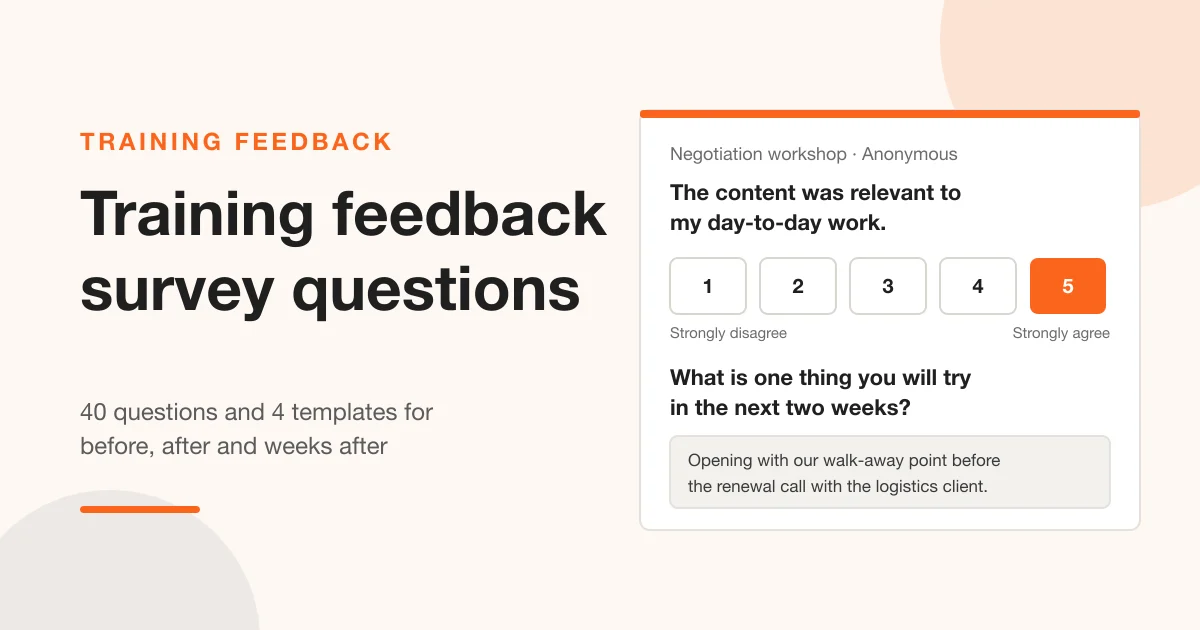
- The content was relevant to my day-to-day work.
- The training covered what I expected it to cover.
- The examples matched situations I actually face.
- The level was... (Too basic / About right / Too advanced)
- Which part was most useful to you? (open)
- Which part could we cut or shorten? (open)
- Was anything important missing? (open)
Question 10 is worth keeping in every survey. When a third of the room says "Too basic" and another third says "Too advanced", you probably have two audiences in one session. Splitting it will fix more than any change to the slides.
Trainer and delivery questions
Feedback on delivery helps the trainer improve, especially internal trainers who teach once a quarter alongside their real job. Ask about specific behaviors you can change, and leave out questions about charisma or likeability.
- The trainer explained things clearly.
- The trainer made it easy to ask questions.
- There was enough time for questions and discussion.
- How was the pace? (Too slow / About right / Too fast)
- The exercises helped me understand the material.
- What could the trainer do differently next time? (open)
If the trainer is a colleague, make these answers anonymous. People are generous with criticism of a vendor and very gentle with someone they'll sit next to at lunch.
Format and logistics questions
Logistics only deserve a question when you can change them. Ask about the length, the format and the materials. Skip the room temperature unless you're the one who controls it.
- The length of the session was... (Too short / About right / Too long)
- How did the format work for you? (Worked well / It was fine / Didn't work for me)
- For virtual sessions: could you hear, see and take part without technical problems? (Yes / Mostly / No)
- The materials will be useful to come back to later.
- Would you prefer this training as... (One longer session / Several shorter sessions / Self-paced with a live Q&A)
Question 24 is useful when you plan to run the training again. Several shorter sessions with practice in between often suit busy teams better than one long afternoon, and your attendees will tell you if you ask.
Learning and confidence questions
People are poor judges of how much they have learned, but they are decent judges of how confident they feel and what they plan to do next. These questions ask for both.
- I could explain the main ideas from this training to a colleague.
- How confident do you now feel doing this in your job? (1 to 5)
- What is one thing you will try in the next two weeks? (open)
- What might stop you from using what you learned? (open)
- What help would make it easier to put this into practice? (A follow-up session / A checklist or guide / Time with an expert / Support from my manager / Nothing, I'm set)
Compare question 26 with question 2 from the pre-training survey. The difference is one of the simplest measures of what a session achieved.
Question 27 does double duty. It nudges people to commit to something specific, and it gives you the exact wording to quote back to them in the follow-up survey.
Follow-up questions, four to six weeks later
This is where you learn whether training changed anything. Send it four to six weeks after the session, long enough for people to have had a chance to use what they learned and soon enough that they still remember the training.
- Since the training, how often have you used what you learned? (Not yet / Once or twice / Regularly)
- The training has made a noticeable difference to my work.
- What did you change after the training? (open)
- What has made it hard to apply what you learned? (No time / No opportunity yet / My manager wasn't aware of it / The tools don't support it / I wasn't sure how / Other)
- Has your manager talked with you about the training since? (Yes / No)
- Looking back, which part of the training was most useful? (open)
- Is there a follow-up topic you'd like training on? (open)
- Would you recommend this training to a colleague in a similar role? (Yes / Maybe / No)
Question 33 is the one to read closely. Plenty of training goes wrong in the weeks after the session, when people go back to a full inbox and nobody mentions it again. When "No opportunity yet" and "My manager wasn't aware of it" keep coming up, a short note to managers before the next session will help more than a better trainer.
Questions for multi-day courses and programs
For longer courses, such as a manager development program or a weeks-long onboarding academy, add a few questions about the program as a whole.
- The program was a good use of my time.
- How was the balance between theory and practice? (Too much theory / About right / Too much practice)
- What should we change before the next group starts? (open)
4 training feedback survey templates
Each template is short enough to answer on a phone. Mark the open questions as optional if you want more people to finish.
1. Pre-training check (a few days before)
- How familiar are you with this topic already? (Not at all / A little / Quite familiar / Very familiar)
- How confident are you doing this in your job today? (1 to 5)
- Is there a specific situation at work you'd like this training to help with? (open, optional)
2. End-of-session survey (two minutes)
- The content was relevant to my day-to-day work. (Strongly disagree to Strongly agree)
- The level was... (Too basic / About right / Too advanced)
- How confident do you now feel doing this in your job? (1 to 5)
- What is one thing you will try in the next two weeks? (open)
- What could we do better next time? (open, optional)
3. Multi-day course review
- The program was a good use of my time. (Strongly disagree to Strongly agree)
- The content was relevant to my day-to-day work. (same scale)
- The trainer explained things clearly. (same scale)
- How was the balance between theory and practice? (Too much theory / About right / Too much practice)
- How confident do you now feel doing this in your job? (1 to 5)
- What should we change before the next group starts? (open)
4. Follow-up check (four to six weeks later)
- Since the training, how often have you used what you learned? (Not yet / Once or twice / Regularly)
- The training has made a noticeable difference to my work. (Strongly disagree to Strongly agree)
- What has made it hard to apply what you learned? (multiple choice, from question 33)
- What did you change after the training? (open, optional)
Use the same wording every time you run a course. Scores from one session mean little on their own. Compared across sessions, trainers and groups, they show which training is worth repeating.
How to write your own training survey questions
You'll want questions about the specific skills a course covers. A few rules keep them useful:
- Ask about one thing per question. "The trainer was clear and engaging" asks two things, and a 3 could mean either.
- Name the training. "The negotiation workshop on Tuesday" gets better answers than "this training", especially from people who attend several sessions a month.
- Ask about behavior, not opinion. "I could explain the main ideas to a colleague" is easier to answer honestly than "I learned a lot".
- Keep the scale the same. Mixing five-point and ten-point scales in one survey slows people down and makes results hard to compare.
- Ask only what you'll act on. If the training budget is fixed and the vendor is chosen, don't ask people whether they'd like a different vendor.
Named or anonymous?
For the end-of-session survey, anonymous answers are usually more useful. Internal trainers are colleagues, and people won't write "the second half dragged" if their name sits next to it. In a group of four or five, though, even anonymous answers can be guessed, so wait until a few sessions have run before sharing open comments with the trainer.
The follow-up survey is a different case. If the point is to help individual people who haven't been able to apply what they learned, you need to know who they are. Say clearly in the message whether the survey is named, and why. Our guide to anonymous polls in Slack covers what anonymity can and can't protect.
What to do with the answers
Send the trainer a summary within a week. Feedback that arrives a month later, after the next session has already run, changes nothing. Include the scores, the open comments and the two or three themes you noticed.
Look at relevance first. A session with a high trainer score and a low relevance score was enjoyable and probably a poor use of time. That usually points to who was invited or what was covered.
Watch the confidence gap. If confidence barely moves between the pre-training and end-of-session surveys, the session explained the topic without giving people enough practice.
Tell managers what their people learned. The follow-up survey often shows that people never got the chance to use a new skill. A two-line note to managers after each session, listing what was covered and what people said they'd try, makes it much more likely that someone asks about it.
Close the loop with attendees. A line in the next invitation such as "Last group asked for more practice, so this session has two role-plays instead of one" shows people that their answers were read.
If you want to know which skills to train in the first place, a skills audit is a good place to start, and new hires often tell you which training they missed in their onboarding surveys.
Running training feedback surveys in Slack
Paper forms and survey links in a follow-up email tend to get answered by the most conscientious people and ignored by everyone else. A survey that arrives in Slack, where people already are when the session ends, gets answered while the training is still fresh.
With Polls & Surveys you can set up each of the templates above once and reuse it for every session:
-
Build the survey. Type
/polland add your questions. You can mix single-choice and multiple-choice questions, a one-to-five rating or agreement scale and written answers in one survey, and mark each question as required or optional. The built-in Meeting feedback template, with a one-to-five usefulness rating and one written question, is a quick starting point for a short session. People who leave halfway can pick up where they stopped. -
Post it before people leave. For a live session, post the survey in the course channel or the channel you used for the session and ask people to answer before the call ends. They answer in a form that opens from the message, and no one has to open another tool. On the Unlimited plan you can instead send it as a private message to the members of that channel or to selected people.
-
Schedule the follow-up now. While you're setting up the end-of-session survey, create the follow-up and use "Schedule for later" to send it five weeks from now. For training you run regularly, a survey can also repeat on a schedule, such as every month or every three months, and each run keeps its own results.
-
Keep trainer feedback anonymous. In an anonymous survey nobody, including poll admins and workspace admins, can see who gave which answer. Set results to "Poll administrators only" so attendees don't see each other's ratings, and add the trainer as a co-admin so they can read the results directly.
The dashboard shows the response rate, a chart for every rating question and each written answer. On the Unlimited plan you can also remind people who haven't answered with one click, export results as a CSV to compare courses, and save each template as a workspace template so every trainer in the company uses the same questions. The free plan allows up to five options per question, which covers every question in this guide.
Mistakes that make training surveys useless
Asking twenty questions. Long end-of-session forms get rushed, and the rushed answers all look the same. Six questions answered with care beat twenty answered with the same number.
Measuring only satisfaction. People can enjoy a session they will never use. Always include at least one question about relevance and one about what they'll do next.
Collecting feedback when people are leaving. A link sent the next morning competes with a full inbox. Leave five minutes at the end of the session and ask people to answer then.
Never following up. Without the follow-up survey, you'll keep running training that people liked and didn't use.
Using scores to rank trainers. Internal trainers volunteer their time. If survey scores become a league table, fewer people volunteer and those who do play it safe.
Ignoring what you heard. If the last three groups said the session was too long and it's still three hours, people stop writing comments.
Frequently asked questions
What questions should a training feedback survey ask?
Ask whether the content was relevant to the person's job, whether the pace and level were right, how clear the trainer was, how confident the person now feels, and what they plan to use first. A few weeks later, ask whether they have actually used it and what got in the way.
When should you send a training feedback survey?
Send a short survey in the last five minutes of the session, while people are still in the room or on the call. Then send a follow-up four to six weeks later to find out whether the training changed how people work. A pre-training survey a few days before is useful for longer courses.
How many questions should a training feedback survey have?
Four to six questions for a single session is enough, and up to eight or nine for a multi-day course. Keep one or two open questions and make the rest quick rating or choice questions so people can answer in two minutes.
Should training feedback surveys be anonymous?
Make questions about the trainer and the session anonymous, because people soften criticism of a colleague when their name is attached. A follow-up about applying the training can be named if a manager or trainer plans to help individual people who are stuck.
Related articles
Written by
Keep reading


 How to Run an Anonymous Poll in Slack
Nov 24, 2026