45 Onboarding Survey Questions for New Hires (+ 4 Templates)
45 onboarding survey questions for week one, day 30, 60 and 90, four short templates, and how to get honest answers from new hires while you can still help.

12 minutes
Table of contents
Onboarding survey questions
A new hire's first weeks are full of things they won't mention unless someone asks. The laptop that arrived on day three. The tool nobody gave them access to. The weekly meeting everyone assumes they understand. The manager who is lovely and always busy. Most of it is easy to fix, if someone hears about it in time.
Many organizations know their onboarding has gaps. In a survey of 350 US HR leaders by Kronos and the Human Capital Institute, reported by SHRM, 76% said new hires weren't being onboarded effectively at their organization, and only 47% said their onboarding program successfully retains new hires. Gallup reports that only 12% of US employees say their company does a good job of onboarding.
The people who know exactly where your onboarding falls short are the ones going through it. Below are 45 onboarding survey questions grouped by when to ask them, four short templates for week one, day 30, day 60 and day 90, and advice on running them so new hires answer honestly.
When to send an onboarding survey
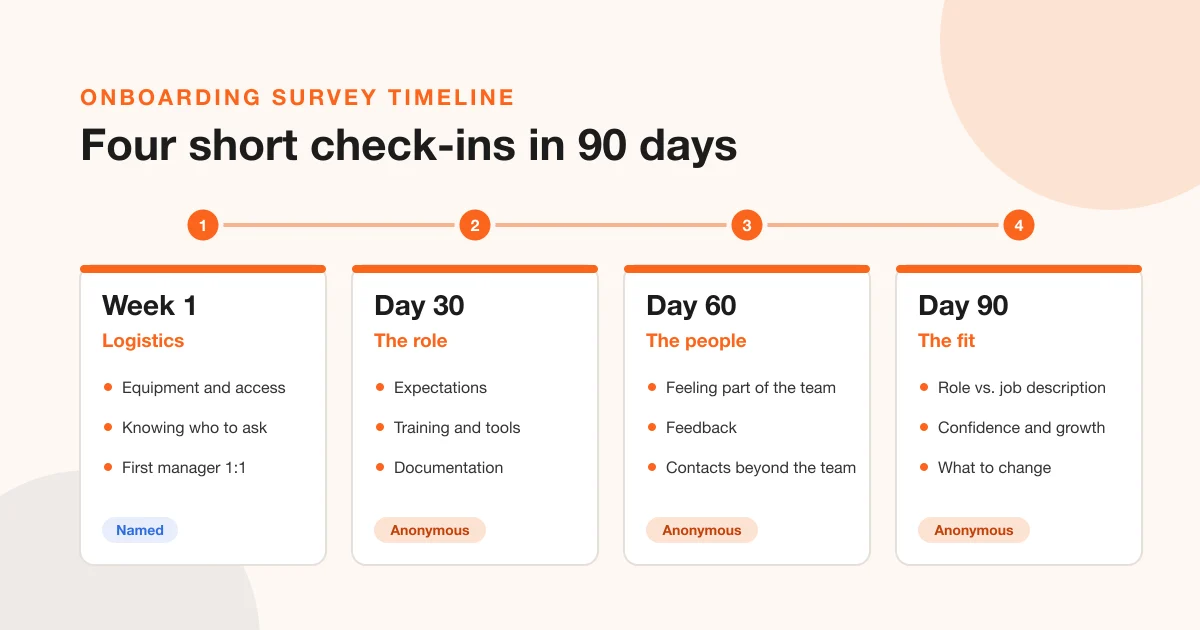
What a new hire can tell you changes quickly. In the first week they know whether their accounts worked and whether anyone said hello. By the third month they know whether the job matches the one they were offered. A single survey can't cover both well, so most teams use a few short checkpoints:
- End of week one: logistics. Equipment, access, a first conversation with the manager, knowing who to ask.
- Day 30: the role. Expectations, training, tools and documentation.
- Day 60: the people. The team, the manager, feedback, contacts outside the team.
- Day 90: the fit. Whether the role matches what was described, confidence, growth, and what onboarding should change.
Keep each survey to four to six questions. New hires are already reading more than anyone else in the company, and a survey they can finish in two or three minutes is one they'll finish.
If you can only manage one survey, send it around day 30. It's early enough to fix what's wrong and late enough that the person has a real view of the job.
Week one questions
The goal this week is to catch practical problems while they're still small. Answers should go to someone who can fix them the same day.
- Did you have everything you needed to start working on your first day? (Yes / Mostly / No)
- Were your laptop, accounts and tool access ready when you needed them? (Yes / Some of them / No)
- Which tool or system are you still waiting for? (open)
- Did you know who to ask when you got stuck? (Yes / Not always / No)
- Have you had a one-to-one with your manager yet? (Yes / Not yet, but it's booked / No)
- How was the pace of your first week? (Too slow / About right / Too much at once)
- How welcome did you feel in your team this week? (1 to 5)
- What was the most useful thing that happened this week? (open)
- Was anything about your first week confusing? (open)
- What's one thing we should have told you before your first day? (open)
Question 10 is the one to keep forever. The answers quietly rewrite your pre-start email over time.
30-day questions
After a month, the new hire knows the job well enough to tell you where the training, tools and documentation fall short. The agree-disagree questions here use a five-point scale from "Strongly disagree" to "Strongly agree".
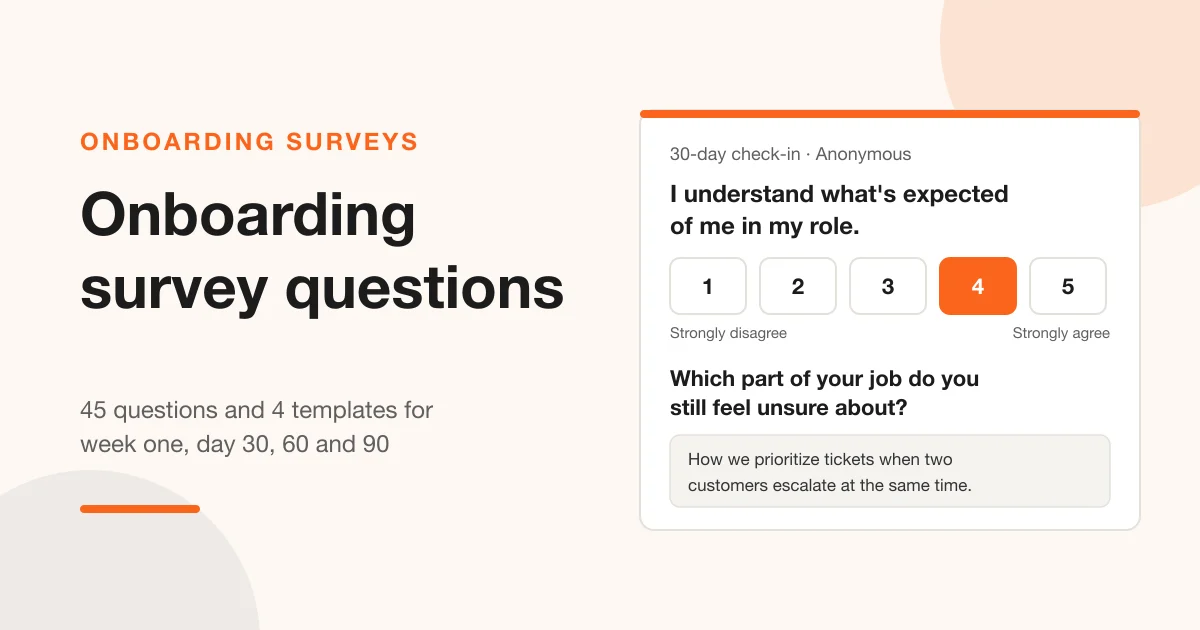
- I understand what's expected of me in my role.
- I know what I should achieve in my first three months.
- The training so far has prepared me for my day-to-day work.
- I can usually find the information I need without asking someone.
- The documentation I've been given is up to date.
- My manager checks in with me... (Too often / About right / Not often enough)
- Has your onboarding buddy been helpful? (Very / Somewhat / Not really / I don't have a buddy)
- Have you contributed to real work yet? (Yes / Not yet, but soon / Not yet, and I'm not sure when)
- Which part of your job do you still feel unsure about? (open)
- Which part of onboarding has been least useful so far? (open)
- What would you change about your first month? (open)
Watch question 15 across several new hires. Out-of-date documentation is one of the most common onboarding complaints, and one of the cheapest to fix once you know which pages people are reading.
60-day questions
By month two the questions move from the job to the people around it: the team, the manager, and the colleagues outside the team who make work easier.
- I feel part of my team.
- I know people outside my own team I can go to with a question.
- I understand how my work contributes to my team's goals.
- I feel comfortable asking questions, even basic ones.
- I get useful feedback on my work.
- My manager and I agree on what I should be working on.
- How many people outside your team have you had a real conversation with? (None / 1 or 2 / 3 to 5 / More than 5)
- Are your ideas heard in team discussions? (Usually / Sometimes / Rarely)
- How is your workload? (Too light / About right / Too heavy)
- What's one thing that would help you work better with your team? (open)
- Is there anything you'd like to raise but haven't found the right moment for? (open)
Questions 23 and 28 show whether the new hire is building a network beyond their own team. If the answer is "None" at day 60, a few introductions or virtual coffee chats with people from other teams can change that within weeks.
Question 32 often gets the most important answers of the whole program. It gives people permission to raise the thing they've been sitting on.
90-day questions
At three months, most new hires have formed a view of the job, the team and whether they see themselves staying. These questions ask for that view, and for honest feedback on the onboarding itself.
- The role matches what was described during hiring.
- I feel confident doing my job without close supervision.
- I can see how I could grow here.
- How likely are you to recommend this company as a place to work? (0 to 10)
- How would you rate your onboarding overall? (1 to 5)
- Which part of onboarding helped you most? (My manager / My buddy / Documentation / Training sessions / Colleagues)
- What should we stop doing in onboarding? (open)
- What was missing that would have helped you get up to speed faster? (open)
- If you were onboarding the next person in your role, what would you tell them? (open)
Question 33 deserves attention from whoever runs hiring. When several people say the role isn't what they were told, the gap usually starts in the job description or the interviews, not in onboarding.
Question 36 is the standard employee Net Promoter Score question. Asking it at day 90 gives you a baseline you can compare with later results; our guide to eNPS survey questions explains how to score and follow it up.
Questions for remote new hires
Starting a job remotely brings its own problems: equipment in the post, colleagues you only see in small rectangles, and a lot of guessing about unwritten rules. Add one or two of these to the relevant checkpoint.
- Did your equipment arrive before your first day? (Yes / On my first day / Later)
- I feel as included in team conversations as colleagues who work in the office.
- Have you met the people you work with most, on video or in person? (Yes, all of them / Some of them / Not yet)
- What has been harder than you expected about starting remotely? (open)
4 onboarding survey templates
Each template is short enough to answer on a phone between meetings. Mark the open questions as optional if you want to keep response rates high.
1. Week one check
- Did you have everything you needed to start working? (Yes / Mostly / No)
- Which tool or system are you still waiting for? (open, optional)
- Did you know who to ask when you got stuck? (Yes / Not always / No)
- What's one thing we should have told you before your first day? (open)
2. 30-day check-in
- I understand what's expected of me in my role. (Strongly disagree to Strongly agree)
- The training so far has prepared me for my day-to-day work. (same scale)
- My manager checks in with me... (Too often / About right / Not often enough)
- Which part of your job do you still feel unsure about? (open)
- What would you change about your first month? (open, optional)
3. 60-day check-in
- I feel part of my team. (Strongly disagree to Strongly agree)
- I know people outside my own team I can go to with a question. (same scale)
- I feel comfortable asking questions, even basic ones. (same scale)
- What's one thing that would help you work better with your team? (open)
4. 90-day review
- The role matches what was described during hiring. (Strongly disagree to Strongly agree)
- I can see how I could grow here. (same scale)
- How likely are you to recommend this company as a place to work? (0 to 10)
- Which part of onboarding helped you most? (My manager / My buddy / Documentation / Training sessions / Colleagues)
- What was missing that would have helped you get up to speed faster? (open)
Use the same wording every time. The value of an onboarding survey grows with each new hire who answers it, because you can compare this quarter's starters with last quarter's.
Named or anonymous?
Onboarding surveys pull in two directions. Anonymity makes people more candid, especially about their manager. But a week-one answer like "I still can't log into the CRM" is only useful if you know whose login to fix.
A split works well for most teams:
- Keep week one named. It's about logistics, and the point is to fix things for a specific person quickly. Say so in the message, so nobody is surprised.
- Make day 30, 60 and 90 anonymous. These ask about the manager, the team and whether the person sees a future at the company. People answer those more honestly without their name attached.
Small numbers need care. If one person joined your company last month, an "anonymous" survey from last month's starters has exactly one possible author. When you hire one or two people a month, read the later surveys in batches, say once a quarter, and share results with managers only when a group is large enough that nobody can be singled out. Our guide to anonymous polls in Slack covers what anonymity can and can't protect.
What to do with the answers
Fix individual problems within a day. The week-one survey exists to help one person settle in. If someone is missing access, the right response is a message from IT that afternoon.
Look for repeats across people. One new hire who found the training too fast is a data point. Three in a row is a program problem. Keep a simple running list of themes from the open questions and count how often each comes back.
Separate program problems from team problems. Out-of-date documentation, slow access and an overloaded first week belong to whoever owns onboarding. A new hire who doesn't feel part of their team is a conversation for that team's manager, handled with care for the anonymity point above.
Compare the checkpoints. Confidence and role clarity should rise between day 30 and day 90. If the averages stay flat, the first months aren't teaching people what they need.
Tell the next group what changed. A line in the welcome message such as "Last quarter's new joiners told us account setup was slow, so IT now prepares accounts the week before you start" shows that answering is worth the effort.
After day 90, new hires can join the same regular check-ins as everyone else. Our guide to employee pulse surveys covers that longer rhythm.
Running onboarding surveys in Slack
Onboarding surveys sent by email compete with dozens of welcome emails, policy documents and calendar invites. A short survey that arrives as a direct message in Slack, where the new hire already spends their day, takes a couple of minutes to answer.
With Polls & Surveys you can build each checkpoint once and reuse it:
-
Build the survey. Type
/polland add questions one by one. You can mix single-choice and multiple-choice questions, a five-point agree-disagree scale and written answers, and mark each question as required or optional. The free plan allows up to five options per question, so the 0 to 10 recommendation question in the 90-day template needs the Unlimited plan. People who leave halfway can come back and pick up where they stopped. -
Send it privately. On the Unlimited plan, the survey can go as a direct message to people you select or to every member of a channel. Many companies already have a channel such as #new-joiners; point the survey there and each run goes to whoever is in the channel at the time. On the free plan, post it in that channel instead, where new hires answer in a form that opens from the message.
-
Repeat it every month. Set the 30-day check-in to repeat monthly, and it reaches each month's newest starters without anyone remembering dates. Each run keeps its own results, so you can compare one month's starters with the next. Use "Schedule for later" when you want to send a one-off survey on a specific date.
-
Make it anonymous where it matters. In an anonymous survey nobody, including poll admins and workspace admins, can see who gave which answer. Set results to "Poll administrators only" so new hires don't see each other's answers.
The dashboard shows the response rate, the answers to each question and every written comment for each run. On the Unlimited plan you can also remind people who haven't answered, export results as a CSV, and save each checkpoint as a workspace template so every team uses the same questions.
A survey is one part of a good start. Our Workflow automation page shows how the 30-day check-in fits with the rest of the first months in Slack: coffee chats with people from other teams, a rotating onboarding buddy, and a first work anniversary that doesn't pass unnoticed.
Mistakes that make onboarding surveys useless
Waiting until the end. A single survey at six months is an exit interview in disguise. The people who had the worst start may already have left, and the ones who stayed have forgotten the details.
Asking about what you can't change. If the benefits package is fixed for the next two years, don't ask new hires to rate it in their first month.
Making it long. Twenty questions at day 30 will get answered once, by the most conscientious people, and skipped by everyone else.
Sending it from the manager. When a survey about the manager comes from the manager, people soften their answers. Let HR or whoever owns onboarding send it and read it.
Treating the score as a manager rating. Onboarding results help improve a process. Use them to rank managers and people will stop answering honestly.
Saying nothing afterwards. If new hires never hear what happened to their feedback, the next group answers with less care.
Frequently asked questions
What questions should an onboarding survey ask?
It depends on when you send it. A week-one survey asks about equipment, access and knowing who to ask. A 30-day survey asks about role clarity, training and tools. A 60-day survey asks about the team, the manager and feedback. A 90-day survey asks whether the role matches what was promised, how confident the person feels and what onboarding should change.
When should you send onboarding surveys to new hires?
A common rhythm is the end of week one, then day 30, day 60 and day 90. If you can only send one, send it around day 30: early enough to fix problems, late enough for the new hire to have a real view.
Should onboarding surveys be anonymous?
Keep the week-one survey named, because its job is to fix practical problems for a specific person. Make the 30, 60 and 90-day surveys anonymous so people can be candid, and when only one or two people join each month, read the answers in batches across a quarter so no single answer can be traced back.
How many questions should an onboarding survey have?
Four to six questions per checkpoint is enough. A new hire is already reading a lot, and a survey they can finish in two or three minutes gets answered. Mix a few rating questions you can compare over time with one or two open questions.
Related articles
Written by
Keep reading
 The 5Cs of Employee Engagement - Framework
Nov 21, 2026