
30 eNPS Survey Questions to Ask in 2026
30 eNPS survey questions, from the core 0–10 question to follow-ups and driver statements, plus a 5-question template and how to calculate your score.

11 minutes
Table of contents
Why eNPS questions matter
Employee Net Promoter Score, or eNPS, is the shortest serious survey you can run. One question on a 0 to 10 scale tells you how many people would recommend your company as a place to work, and one follow-up tells you why.
That simplicity is also the trap. A single number with no context is easy to collect and hard to act on. A team lead who learns that their eNPS dropped from +20 to +5 still has no idea whether the cause is workload, a new manager, or the office move. The questions you put around the score matter as much as the score itself.
Below you'll find 30 eNPS survey questions: the core question, follow-ups that explain the score, driver statements that show where to act, and questions for specific moments such as onboarding or a reorg. There's also a five-question template you can send this week and a worked example of the calculation.
What is eNPS?
Net Promoter Score was created in 2003 by Fred Reichheld, a partner at Bain & Company, and introduced in the Harvard Business Review article The One Number You Need to Grow. It started as a way to measure customer loyalty. Companies later turned the same idea inward and asked their own people.
According to Bain's page on employee NPS, most companies that use it have settled on one central question: how likely employees are to recommend the company as a place to work. Bain also says it has found this "likelihood to recommend" question to be the best predictor of retention.
eNPS is one of several employee engagement KPIs worth tracking. Its strength is that it's quick to answer and easy to repeat, so you can watch it move from one quarter to the next.
How to calculate eNPS
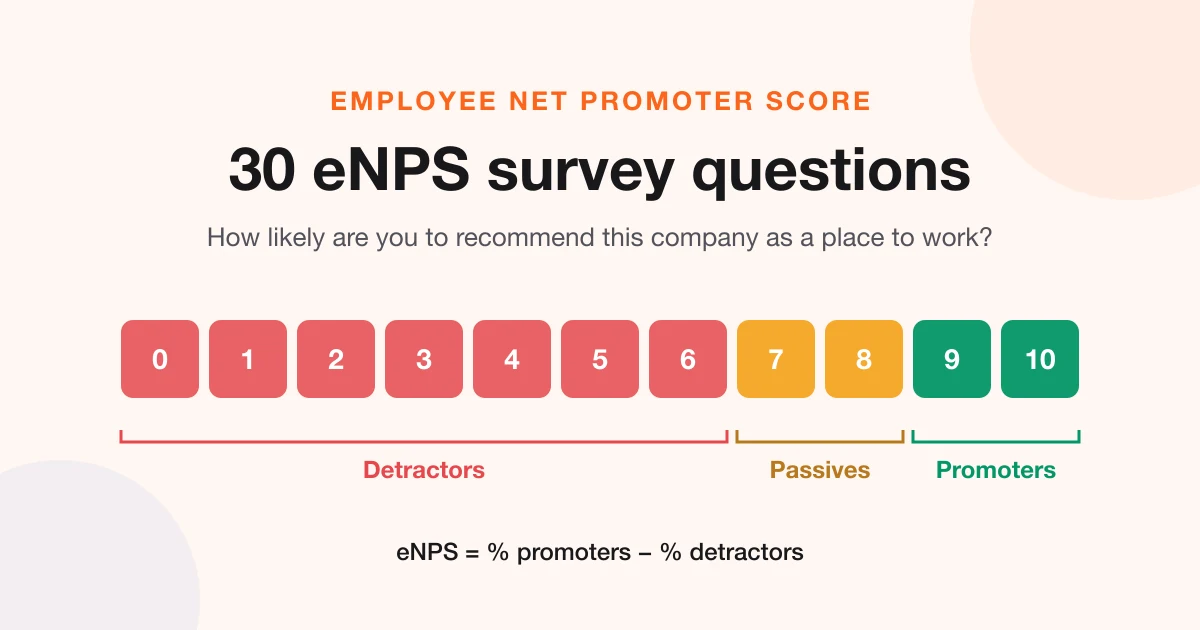
Every answer to the 0 to 10 question puts the respondent in one of three groups. The bands below are the ones Bain uses for the Net Promoter Score:
- Promoters answer 9 or 10.
- Passives answer 7 or 8.
- Detractors answer 0 to 6.
Your eNPS is the percentage of promoters minus the percentage of detractors. Passives count toward the total number of respondents but not toward either group.
Here's a worked example. Say 40 people answer. Eighteen give a 9 or 10, fourteen give a 7 or 8, and eight give 6 or lower. Promoters are 18 out of 40, or 45%. Detractors are 8 out of 40, or 20%. Your eNPS is 45 minus 20, which is +25.
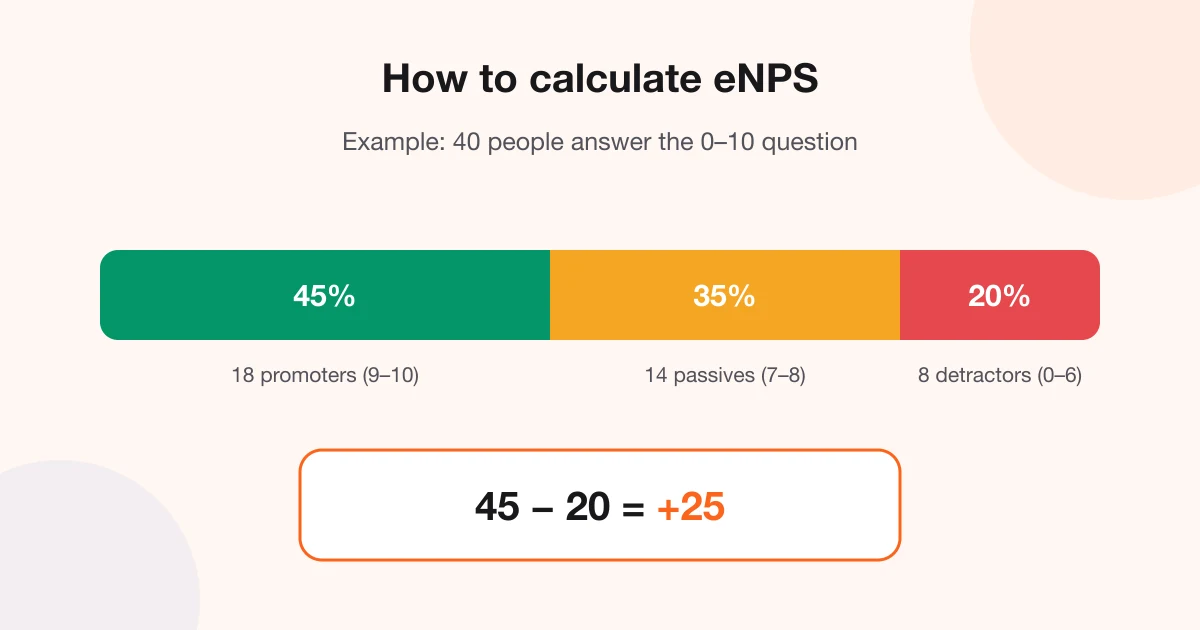
Because the score is one percentage minus another, it can run from -100 (everyone is a detractor) to +100 (everyone is a promoter). It's written as a whole number, not a percentage, which is why people say "plus twenty-five" rather than "twenty-five percent".
The core eNPS question
These three cover the score itself. Pick one and keep the wording identical every time you run the survey, or your trend line stops meaning anything.
-
"On a scale from 0 to 10, how likely are you to recommend this company as a place to work?" The standard version. Use it unless you have a strong reason not to.
-
"How likely are you to recommend working here to a friend who is looking for a job?" A slightly more concrete phrasing. Some people find it easier to answer when they picture a real friend.
-
"How likely are you to recommend this team to a colleague who wants to move internally?" A team-level variant for larger companies. It measures something different from company eNPS, so report it separately.
Follow-up questions that explain the score
The score tells you how many people would recommend you. The follow-up tells you what to do about it. Ask at least one of these as an open question, right after the score.
-
What is the main reason for your score?
-
What is one thing that would raise your score by a point?
-
What would you tell a friend is the best part of working here?
-
What almost stopped you from giving a higher score?
-
If you could change one thing about working here tomorrow, what would it be?
-
What should we keep doing no matter what changes?
-
Is there anything you'd like leadership to know that this survey didn't ask?
Question 5 is underrated. "Why did you give a 6?" invites a list of complaints. "What would make it a 7?" invites a specific, often small, fixable request, such as fewer recurring meetings, a clearer promotion process, or a laptop that doesn't crash during calls.
Driver questions that show where to act
Driver questions are statements people rate on an agreement scale, usually from "Strongly disagree" to "Strongly agree". Add two to four of them to your eNPS survey, rotating topics from one round to the next, and you'll see which part of work life moves with the score.
Manager and support
-
My manager gives me useful feedback on my work.
-
I have the support I need to do my best work.
-
I would feel comfortable raising a concern with my manager.
Growth
-
I can see a path for my career here.
-
I've learned something new in my role in the last three months.
-
I have access to the training I need.
Workload and wellbeing
-
My workload is manageable most weeks.
-
I can disconnect from work outside my working hours.
Recognition and belonging
-
When I do good work, someone notices.
-
I feel like I belong on my team.
-
People here treat each other with respect.
Clarity, purpose and tools
-
My priorities are clear.
-
I understand how my work contributes to the company's goals.
-
My job inspires me. (Bain mentions this statement as a common second question alongside the recommendation question.)
-
I have the tools and information I need to do my job well.
-
Decisions that affect my work are explained to me.
If you want more statements to rotate in, our list of employee pulse survey questions works well alongside eNPS.
Questions for specific moments
Sometimes you run eNPS right after something happened and want to know how that event shaped the score. Add one of these as an extra open question.
-
New joiners: "How well did your first 90 days match what you were told during hiring?"
-
After a reorg: "How confident are you that the recent changes will make your work easier?"
-
After a policy change: "How has the new hybrid work policy affected your ability to do your job?"
-
Before a busy period: "What would make the next quarter feel more sustainable than the last?"
A five-question eNPS survey template
This takes about two minutes to answer, which keeps response rates up when you repeat it.
- On a scale from 0 to 10, how likely are you to recommend this company as a place to work? (0–10 scale)
- What is the main reason for your score? (free text)
- My priorities are clear. (agreement, 1–5)
- I have the support I need to do my best work. (agreement, 1–5)
- What is one thing that would raise your score by a point? (free text, optional)
Keep questions 1 and 2 fixed. Swap questions 3 and 4 each round with driver statements from the list above, so over a year you cover most topics without making any single survey longer.
How to run an eNPS survey people trust
Make it anonymous and say so. People rarely give a 3 with their name attached. Tell them in the invitation who will see the results and in what form, for example "Only HR sees individual answers, and nobody can see who wrote what."
Don't report on groups that are too small. If a team of four gets its own breakdown, everyone can guess who the detractor is. Combine small teams until each group is large enough that individual answers can't be picked out.
Keep it short. eNPS works because it's quick. A 40-question survey with an eNPS question at the end is an engagement survey, and it will get engagement-survey response rates.
Choose a steady cadence. Quarterly suits most teams: often enough to see whether changes worked, with enough time between rounds to make some. Monthly can work if the survey stays at two or three questions.
Share results within two weeks. Post the score, the main themes from the comments, and one or two things you'll change. Then report back next round on whether you did. A short, honest update ("we heard that priorities change too often, so planning now happens monthly instead of weekly") does more for the next response rate than any reminder.
How to read your eNPS
Watch the trend, not one number. A first score of +10 tells you very little. Moving from +10 to +22 over three quarters tells you something is working.
Read the comments by group. Sort the open answers into promoters, passives and detractors before you look for themes. Promoters tell you what to protect, detractors tell you what's broken, and the two lists are often about the same topics seen from different sides.
Don't ignore the passives. They don't affect the score, but a 7 or 8 is often one or two small fixes away from a 9. Their comments are frequently the most practical in the whole survey.
Check the response rate. A score from 30% of the company describes the people who chose to answer. If response rates fall, find out why before you trust the number.
Be careful with outside benchmarks. Published averages vary with the vendor, the industry and how the survey was run, so they rarely compare like with like. Bain also notes that employee scores can be substantially lower than customer scores, so don't hold your eNPS against your customer NPS either. Your own past results are the most reliable comparison. If you want to combine eNPS with other measures into one view, see our guide to the employee engagement score.
How to run an eNPS survey in Slack
Email surveys compete with a full inbox. If your team lives in Slack, asking there usually gets more answers with less chasing.
Polls & Surveys includes an Employee NPS template with the standard 0 to 10 question and a follow-up asking for the main reason behind the score. Anonymous responses are suggested by default, and when a poll is anonymous, no one, including poll and workspace admins, can see who answered. You can add driver statements on a 1 to 5 agreement scale to the same survey.
A few settings are worth changing for eNPS:
- Repeat it on a schedule, for example monthly, so each run is saved separately and you can compare them over time.
- Show results to poll administrators only, so early answers don't influence later ones.
- Send it as a private message to everyone in the workspace or the members of a channel, so nobody answers in front of colleagues.
- Remind people who haven't answered before the survey closes.
In the results view, answers to the 0 to 10 question are grouped into detractors (0–6), passives (7–8) and promoters (9–10) with counts and percentages, so your eNPS is one subtraction away. Private delivery, reminders and CSV export are part of the Unlimited plan. If you're new to running questions in Slack, our guide on how to create a poll in Slack covers the basics.
Common eNPS mistakes
Asking only the score. Without a follow-up, a low eNPS starts a guessing game in the leadership meeting. One open question is enough to turn the number into a list of things to look at.
Surveying too often. If people answer every two weeks and nothing changes, they stop answering. Survey only as often as you can act and report back.
Promising anonymity you can't keep. Collecting team, tenure, location and role on a small team identifies people as surely as asking their name. Ask only for the demographic fields you'll actually use, and make sure each group stays large.
Chasing a published average. A 30-person startup and a 30,000-person retailer will get very different scores for reasons that have little to do with how well either is run.
Treating detractors as a problem to manage. Someone who gives a 4 and explains why has done you a favor. If detractors feel singled out after a survey, next round they'll either give a 9 or skip it, and you lose the most useful signal you had.
Frequently asked questions
What is a good eNPS score?
Any score above zero means you have more promoters than detractors. Published benchmarks vary with the vendor, industry and method, so the most useful comparison is your own score over time, read together with the comments behind it.
How often should you run an eNPS survey?
Quarterly is a sensible default for most teams. It gives you enough time between rounds to act on what you learned. A monthly cadence can work if the survey stays at two or three questions.
What is the difference between eNPS and an engagement survey?
eNPS is one question that measures advocacy: would people recommend working here? An engagement survey covers many drivers, such as management, growth, workload and recognition, in more depth. Many teams run eNPS every quarter and a fuller engagement survey once a year.
Related articles
Written by
Keep reading
 The 5Cs of Employee Engagement - Framework
Nov 21, 2026