35 Psychological Safety Survey Questions for Teams
35 psychological safety survey questions grouped by theme, three ready-to-send templates, and how to run the survey anonymously and talk through the results.

12 minutes
Table of contents
Psychological safety survey questions
A team finishes a project that slipped by three weeks. In the retrospective, everyone agrees communication could have been better, someone suggests a new board column, and the meeting ends early. Two days later, over coffee, one of the engineers mentions that they saw the problem coming in week two but didn't want to be the person who slowed everything down.
That gap between what people know and what they say out loud is what psychological safety describes. Harvard professor Amy Edmondson, who introduced the idea in team research, defines it as a shared belief that the team is safe for interpersonal risk taking: asking a naive question, admitting a mistake, disagreeing with the most senior person in the room.
Psychological safety is hard to see from the outside, and a team lead is often the last person to notice when it's missing. A short anonymous survey is one of the few ways to find out. Below are 35 psychological safety survey questions grouped by theme, three templates for different situations, and practical advice on running the survey and turning the results into a useful team conversation.
What psychological safety means at work
People sometimes hear the phrase and picture a team where everyone is pleasant and nobody pushes back. Edmondson's research describes something more demanding. On a psychologically safe team, people point out problems early, disagree in the open and admit what they don't know, because they trust that doing so won't cost them their standing. High standards and honest conflict fit comfortably inside that.
The idea got wide attention after Google studied its own teams. Its re:Work guide on team effectiveness describes research across 180 teams, 115 project teams in engineering and 65 pods in sales, and lists five dynamics that set effective teams apart. Psychological safety comes first, ahead of dependability, structure and clarity, meaning and impact. The researchers concluded that how a team worked together mattered more than who was on it.
Edmondson's own work goes back further. Her 1999 paper in Administrative Science Quarterly studied 51 work teams at a manufacturing company and found that psychological safety was linked to learning behavior: asking for feedback, discussing errors, seeking help. That's the practical reason to care. A team that can't talk about mistakes keeps repeating them.
The original seven-item scale
Most psychological safety surveys trace back to the seven statements Edmondson used in that 1999 study. Team members rate how accurately each one describes their team. In plain terms, the statements cover:
- Whether a mistake on this team tends to be held against you
- Whether members can bring up problems and tough issues
- Whether people are sometimes rejected for being different
- Whether it's safe to take a risk on this team
- Whether it's difficult to ask teammates for help
- Whether anyone on the team would deliberately undermine your efforts
- Whether your unique skills and talents are valued and used
Three of the seven are worded negatively (mistakes, rejection and asking for help), so agreement with them signals less safety. If you use the scale, flip those scores before you average anything, or the results will look better than they are.
The original wording is a good starting point if you want a short survey that has been used in research for decades. Many teams adapt it, though. Rating "accuracy" on a seven-point scale feels academic to some people, and the questions don't ask about the team lead's behavior, which is usually the first thing that needs to change. The list below keeps Edmondson's themes and adds questions you can act on.
How to write good psychological safety questions
A few habits make the difference between a survey that produces a useful conversation and one that produces a vague average.
Ask about the team, not the person. "On this team, people can admit a mistake without it being held against them" asks about a shared norm. "I am comfortable admitting mistakes" mixes the team climate with personality, and a confident person will agree on any team.
Describe a behavior. "Our team has a good culture" invites a gut reaction. "When someone raises a concern in a meeting, it gets discussed rather than brushed aside" describes a moment people can picture.
Mix positive and negative wording carefully. Edmondson's scale uses both to catch people who agree with everything. That works in research, but in a short team survey negative statements confuse people who are answering on their phone between meetings. The questions below are all phrased positively, so agreement always means more safety.
Use one scale for every statement. Five points from "Strongly disagree" to "Strongly agree" is easy to answer and easy to compare from one round to the next.
Speaking up
- On this team, I can raise a problem even when it's awkward or inconvenient.
- When someone raises a concern in a meeting, it gets discussed rather than brushed aside.
- I can say "I don't know" without feeling judged.
- People here bring up bad news early, before it becomes a crisis.
- I can question a decision made by someone more senior than me.
Question 4 often tells a team lead more than any other. If people agree that bad news travels early, most of the other questions tend to score well too.
Mistakes and learning
- When I make a mistake, it isn't held against me.
- We talk openly about what went wrong on a project, without looking for someone to blame.
- People on this team admit their mistakes, including the team lead.
- When something fails, we focus on what we can learn from it.
- I've seen someone admit a mistake here and be treated fairly afterwards.
Question 10 asks about something people have actually seen. Agreeing that mistakes are "accepted" in principle is easy; remembering a time it happened is a stronger signal.
Asking for help
- It's easy to ask a teammate for help.
- People on this team are willing to make time to help each other.
- I can ask a basic question without worrying about looking incompetent.
- New people on the team feel comfortable asking questions.
Taking risks and sharing ideas
- It's safe to try a new approach on this team, even if it might not work.
- Ideas are judged on their merit, not on who suggested them.
- I feel comfortable sharing an idea that isn't fully formed yet.
- When someone suggests something unusual, people build on it before criticizing it.
Disagreement and conflict
- People on this team can disagree openly with each other.
- Disagreements here are about the work, not about the person.
- When we disagree, we usually reach a decision that everyone can commit to.
- I can push back on a deadline or a request when I think it's unrealistic.
Question 22 is particularly useful on teams under delivery pressure. If people can't say a deadline is unrealistic, the team finds out when it's missed.
Inclusion and belonging
- People on this team are accepted for who they are.
- My skills and experience are valued and used here.
- Everyone gets heard in discussions, not only the loudest voices.
- People who work remotely or in a different time zone have the same say as everyone else.
- Nobody on this team would deliberately make my work harder.
Question 26 is worth adding for distributed teams, where decisions can quietly happen in the office or in a meeting that half the team couldn't attend.
The team lead
- My team lead responds constructively when someone brings them bad news.
- My team lead asks for input before making decisions that affect us.
- My team lead admits when they don't know something or got something wrong.
- My team lead protects people who speak up, including when they disagree with them.
These four belong in the survey only if the team lead is ready to hear the answers and the group is large enough for anonymity to hold. For a fuller set, see our manager feedback survey questions.
Open questions
- What makes it easier to speak up on this team? (open)
- What makes it harder? (open)
- Think of a time you held back from saying something at work. What would have helped you say it? (open, optional)
- What's one thing we could change that would make this team feel safer? (open)
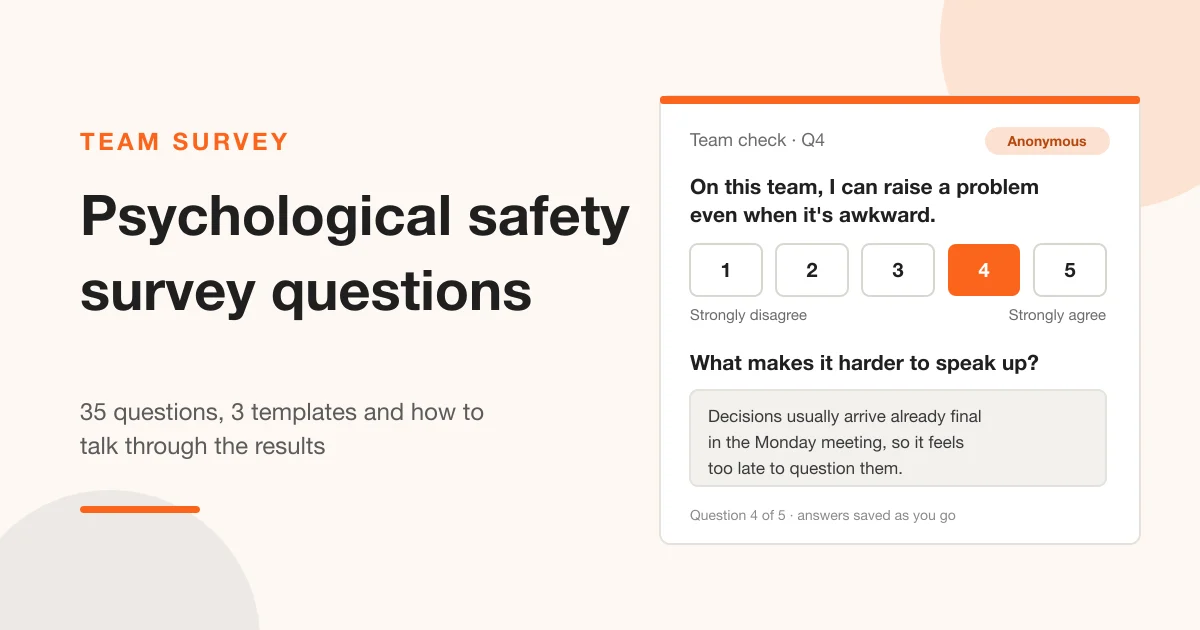
Questions 32 and 33 are the pair that matters most. A low score on "I can question a decision" could mean many things, while a comment like "decisions arrive already final in the Monday meeting" tells the team exactly what to change.
3 psychological safety survey templates
1. Monthly team check (five questions)
A short survey for a regular rhythm, so the team can see whether things are moving.
- On this team, I can raise a problem even when it's awkward or inconvenient. (Strongly disagree to Strongly agree)
- When I make a mistake, it isn't held against me. (same scale)
- It's easy to ask a teammate for help. (same scale)
- People on this team can disagree openly with each other. (same scale)
- What's one thing we could change that would make this team feel safer? (open, optional)
2. Twice-yearly team survey (twelve questions)
A fuller survey that covers Edmondson's themes and gives the team enough material for a proper discussion.
- On this team, I can raise a problem even when it's awkward or inconvenient.
- People here bring up bad news early, before it becomes a crisis.
- When I make a mistake, it isn't held against me.
- We talk openly about what went wrong on a project, without looking for someone to blame.
- It's easy to ask a teammate for help.
- It's safe to try a new approach on this team, even if it might not work.
- People on this team can disagree openly with each other.
- People on this team are accepted for who they are.
- My skills and experience are valued and used here.
- My team lead responds constructively when someone brings them bad news.
- What makes it easier to speak up on this team? (open)
- What makes it harder? (open)
All statements use the same five-point agreement scale.
3. After a hard moment (four questions)
For the weeks after an incident, a failed launch, a reorganization or a difficult change of plan, when people are most likely to stay quiet.
- I felt able to raise concerns during [the incident / the launch / the change]. (Strongly disagree to Strongly agree)
- The way we reviewed what happened focused on learning, not blame. (same scale)
- I know what we're changing as a result. (same scale)
- Is there anything about what happened that you haven't felt able to say? (open, optional)
Send it after the formal review, not before. People need to see how the team handles the review itself before they'll answer honestly about it.
How to run the survey
Make it anonymous, and make sure people believe it. On a team where people don't feel safe speaking up, very few will say so under their own name. Tell everyone in the invitation message that answers are anonymous, who will see the results, and what will happen with them. Our guide to anonymous polls in Slack covers what anonymity can and can't protect.
Mind the group size. With three people on a team, anonymity is mostly a formality. Wait for at least five answers before showing results, and for smaller teams combine results with a neighboring team or replace the survey with a facilitated conversation led by someone outside the reporting line.
Let the team own the results. Psychological safety is a property of the team, so the team should see its own results first, before they go into a company-wide report. A survey that feels like it's collecting evidence for leadership will make people more careful, which is the opposite of what you want.
Pick a calm week. Avoid sending the full survey in the middle of a crunch or the day after a difficult announcement, unless you're using the "after a hard moment" template on purpose. Answers given under stress tell you about that week more than about the team.
Say what happens next. Put the date of the results discussion in the invitation. Knowing there will be a conversation, and when, is one of the strongest reasons to answer honestly.
How to read the results and talk about them
Start with the spread, not the average. A statement where everyone answered "Agree" and one where half the team strongly agreed and two people strongly disagreed can have the same average. The second one is the one to talk about: it means some people experience the team very differently from others.
Then compare themes. A team might score well on asking for help and poorly on disagreement, which usually points to a team that is friendly but avoids conflict. Another might score well on speaking up and poorly on mistakes, which suggests people raise problems but worry about being blamed for them.
Read the open answers last, and look for repeated phrases. Two or three people describing the same meeting or the same habit is your most specific lead.
Then hold a short discussion with the team, ideally within two weeks. Something like this works well in 30 to 45 minutes:
- The team lead goes first. They share the results, including the uncomfortable parts, and thank people for answering honestly. If the results include feedback about the lead, saying so out loud does more for safety than any action plan.
- Ask what surprised people. Let the team interpret the numbers. They usually know exactly why a score is low.
- Pick one or two changes. For example: "Anyone can stop a release if they think something is wrong, no justification needed in the moment," or "We start every retrospective with what the team lead got wrong."
- Agree how you'll know. Rerun the five-question check in a month or a quarter and compare.
If a direct conversation feels too exposed at first, collect reactions with an anonymous follow-up poll, or use some of the questions from our list of retrospective questions, which already give people a structured way to talk about how the team works.
Running a psychological safety survey in Slack
A psychological safety survey only works if answering feels safe and takes a couple of minutes. A short survey that arrives as a Slack message, with a clear note that answers are anonymous, fits that better than a link in an email.
With Polls & Surveys you can build and repeat the survey inside Slack:
-
Build the survey once. Type
/poll surveyand add the questions you chose. Rate statements on a five-point agreement scale from "Strongly disagree" to "Strongly agree", add written questions, and mark each one as required or optional. Answers are saved as people go, so someone who gets interrupted can pick up where they left off. -
Make it anonymous. In an anonymous survey nobody, including poll admins and workspace admins, can see who gave which answer, and every question tells respondents so. If you send an anonymous poll privately to fewer than five people, the preview warns you that answers would be easy to guess.
-
Choose who sees results. Set results to "Poll administrators only" so the person running the survey sees the dashboard first and can prepare the team discussion. You can add a co-admin, for example someone from the People team, to read the results with you.
-
Send it to the team. Post the survey in the team's channel, where people answer in a form that opens from the message. On the Unlimited plan you can instead send each team member a private copy, and remind people who haven't answered yet.
-
Repeat it. Set the five-question check to repeat every month or every quarter. Each run keeps its own results, so you can compare this round with the last.
The dashboard shows the response rate, a histogram for every rating question, which makes the spread of answers easy to see, and every written answer. On the Unlimited plan you can also export results as a CSV.
Mistakes to avoid
Using the survey to find out who said what. Even one attempt to guess the author of a comment, if the team hears about it, undoes the whole exercise. Treat anonymous answers as anonymous, including in private.
Reporting results upward before the team sees them. Ranking teams against each other on psychological safety pushes team leads to manage the score rather than the climate.
Running it and going quiet. A team that answers honestly and hears nothing back learns that speaking up doesn't change anything, which is exactly the belief the survey was meant to challenge.
Treating a high score as permanent. A new team lead, a reorganization or a few tense months can change the picture quickly. A short recurring check catches that while it's still easy to talk about.
Asking only in a survey. The survey tells you where to look. The change happens in meetings, one-to-ones and the way the team lead reacts to the next piece of bad news.
Frequently asked questions
What questions measure psychological safety?
The most widely used set comes from Amy Edmondson's 1999 research: seven statements about whether mistakes are held against people, whether members can raise problems and tough issues, whether people are rejected for being different, whether it's safe to take a risk, whether it's hard to ask for help, whether anyone would undermine your efforts, and whether your skills are valued. Most teams adapt those themes and add questions about disagreement, inclusion and how the team lead responds to bad news.
How often should you run a psychological safety survey?
A full survey twice a year is enough for most teams, with a short five-question check every month or quarter to see whether the changes you agreed on are noticed. Running the long version more often gives people little time to see anything change between rounds.
Should a psychological safety survey be anonymous?
Yes. On a team where people don't feel safe, they won't say so with their name attached. Keep it anonymous, only show team results when at least five people have answered, and say upfront who will see the answers.
What is a good psychological safety score?
There is no universal benchmark that fits every team and question set. Compare a team with its own earlier results, look at the spread of answers as well as the average, and pay most attention to the items where several people disagree.
Related articles
Written by
Keep reading
 The 5Cs of Employee Engagement - Framework
Nov 21, 2026