
45 Manager Feedback Survey Questions (Upward Feedback)
45 manager feedback survey questions for upward reviews, four ready-to-send templates, and how to keep answers anonymous when a manager has a small team.

12 minutes
Table of contents
Manager feedback survey questions
Ask a team whether their manager gives useful feedback and most people will say yes in the meeting. Ask the same question in an anonymous survey and you'll often hear something more specific: the one-to-ones that keep getting moved, the priorities that change every Monday, the praise that only ever goes to the same two people.
That difference matters, because few people shape someone's working week as much as their manager. Gallup estimates that managers account for at least 70% of the variance in employee engagement scores across business units. And managers are the people who hear the least honest feedback about their own work. Their teams have every reason to stay polite.
An upward feedback survey, also called a manager feedback or manager effectiveness survey, gives the team a safe way to tell their manager what's working and what isn't. Below are 45 manager feedback survey questions grouped by topic, four templates for different situations, and practical advice on anonymity, small teams and what managers should do with the results.
What an upward feedback survey is for
An upward feedback survey asks direct reports about one person: their manager. That makes it narrower than a 360 review, which collects views from peers, reports and the manager's own boss, and more personal than an engagement or pulse survey, which asks about the company as a whole.
The goal is to help the manager get better. A good survey tells a manager which habits to keep, which ones to drop, and how their team's experience differs from what they assume it is.
A well-known example is Google's manager feedback survey. According to a 2017 Quartz report republished by Government Executive, employees fill it out twice a year. It has 13 questions: 11 statements rated on a five-point agree-disagree scale and two open questions asking what the manager should keep doing and what they should change. Google describes the feedback as developmental and says it isn't directly considered in performance or compensation reviews. You don't need anything that elaborate, but the shape works well: a handful of behavior questions, two open questions, and a clear promise about how the results will be used.
How to write good manager feedback questions
The questions below share a few habits worth keeping if you write your own.
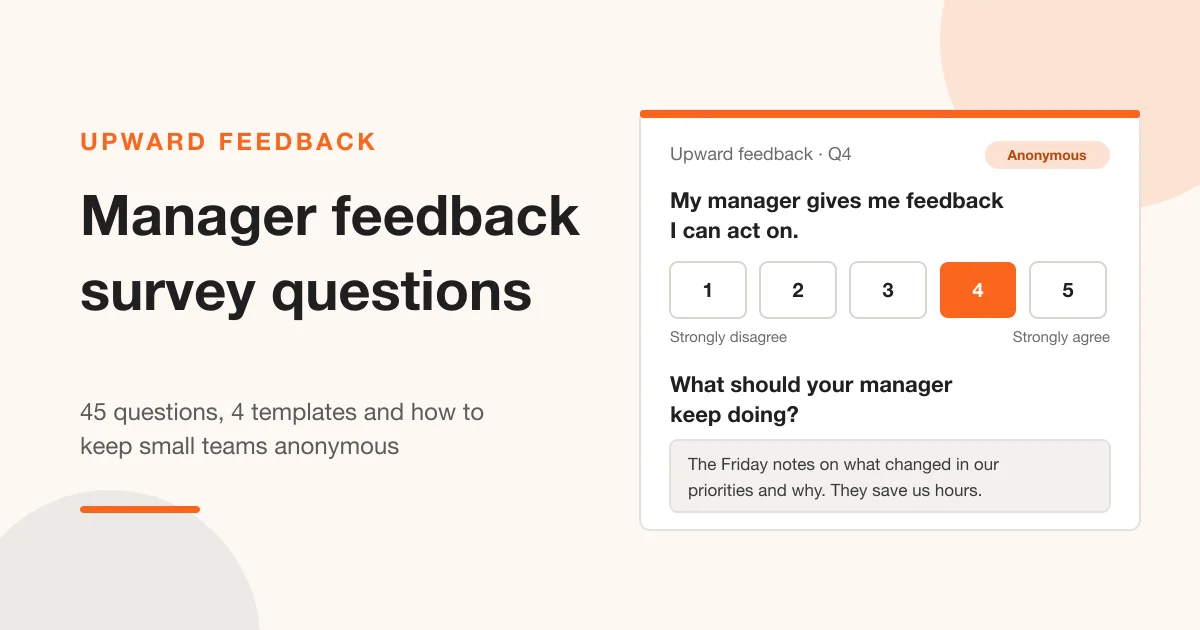
Each one describes a behavior. "My manager is a good leader" invites a gut reaction, while "My manager gives me feedback I can act on" describes something a manager can do more of next month.
Each one is about something the manager controls. If salaries follow a pay band and facilities chose the office, leave those topics out. Low scores on things a manager can't change make the rest of the report harder to read.
Each one asks a single thing. "My manager is approachable and gives clear direction" is really two questions, and a 3 could mean either.
And they all use one scale. Every statement below works with five points from "Strongly disagree" to "Strongly agree", which makes the survey faster to answer and the results easy to compare from one round to the next.
Clarity and priorities
- My manager makes it clear what's expected of me.
- I understand how my work connects to the team's goals.
- My manager keeps the team focused on the most important work.
- When priorities change, my manager explains why.
- My manager helps me say no to work that doesn't fit our priorities.
- I know how my performance will be judged.
Feedback and coaching
- My manager gives me feedback I can act on.
- I get feedback often enough to improve before my review.
- My manager recognizes good work, including work that isn't very visible.
- When I make a mistake, my manager helps me learn from it.
- My manager is open to feedback about their own work.
- Our one-to-ones are a good use of my time.
Question 9 often tells you more than it seems to. Managers tend to notice the work that shows up in meetings and demos, and the people doing quieter work, such as support, documentation or fixing things before they break, are the first to say they go unnoticed.
Support, workload and autonomy
- My manager trusts me to decide how to do my work.
- My manager does not micromanage me.
- My manager helps remove obstacles that slow me down.
- My workload is manageable most weeks.
- I can raise a problem with my manager without worrying about how it will be received.
- My manager is available when I need help.
- My manager respects my time outside working hours.
Growth and career
- My manager and I have talked about my career in the last six months.
- My manager helps me develop skills I need for the next step.
- I'm given work that stretches me.
- My manager supports me in finding opportunities, even outside our team.
- I can see a path to grow here.
Question 20 is concrete on purpose. Everybody agrees in principle that career conversations are important, so "My manager supports my career" gets agreeable answers. Asking whether one actually happened in the last six months gets a yes or a no.
Trust, fairness and respect
- My manager treats everyone on the team fairly.
- My manager values different perspectives, even when they disagree.
- My manager keeps their commitments.
- My manager handles conflict on the team well.
- My manager shows care for me as a person.
- I trust my manager to represent my work fairly to others.
Communication
- My manager shares relevant information from leadership.
- I hear about decisions that affect me before they happen, not after.
- Team meetings run by my manager are useful.
- My manager explains the reasoning behind decisions.
- My manager is clear and direct in written messages.
Question 35 is worth adding for remote and hybrid teams, where most of a manager's direction arrives in Slack rather than in person.
Team and collaboration
- My manager builds good working relationships with other teams.
- People on our team help each other.
- My manager makes sure everyone gets heard in discussions, not only the loudest voices.
- My manager deals with problems on the team instead of letting them drag on.
Overall questions
- Overall, I'm satisfied with my manager. (Strongly disagree to Strongly agree)
- I would recommend my manager to a friend looking for a job. (Strongly disagree to Strongly agree)
- Compared with six months ago, my manager is... (Better / About the same / Worse / I've worked with them less than six months)
Open questions
- What should your manager keep doing? (open)
- What should your manager do differently? (open)
- Is there anything else you'd like your manager to know? (open, optional)
Questions 43 and 44 tend to be the most useful part of the whole report. A low score on feedback could mean almost anything; a comment saying "I'd like feedback before the work is finished, not after" tells the manager exactly what to change.
4 manager feedback survey templates
1. Quarterly upward check (five questions)
A short survey managers can run every quarter to see whether the change they promised is noticed.
- My manager makes it clear what's expected of me. (Strongly disagree to Strongly agree)
- My manager gives me feedback I can act on. (same scale)
- My manager helps remove obstacles that slow me down. (same scale)
- What should your manager keep doing? (open)
- What should your manager do differently? (open)
2. Twice-yearly upward review (twelve questions)
A fuller survey for an HR-run program across all managers.
- My manager makes it clear what's expected of me.
- My manager keeps the team focused on the most important work.
- My manager gives me feedback I can act on.
- My manager recognizes good work, including work that isn't very visible.
- My manager trusts me to decide how to do my work.
- My manager and I have talked about my career in the last six months.
- My manager treats everyone on the team fairly.
- My manager shares relevant information from leadership.
- I can raise a problem with my manager without worrying about how it will be received.
- Overall, I'm satisfied with my manager.
- What should your manager keep doing? (open)
- What should your manager do differently? (open)
All statements use the same five-point agreement scale.
3. New manager check-in (around day 90)
For someone promoted into management or a manager who has just taken over a team.
- I know what my new manager expects of me. (Strongly disagree to Strongly agree)
- My manager has taken time to understand how the team works. (same scale)
- I feel comfortable raising concerns with my new manager. (same scale)
- Since the change, the team's priorities are... (Clearer / About the same / Less clear)
- What's one thing your manager should know about how the team works best? (open)
4. Skip-level conversation guide (for teams of four or fewer)
When a team is too small for an anonymous survey, a conversation with the manager's own boss works better. These are questions for the skip-level manager to ask, and to summarize back without names.
- What does your manager do that helps you most?
- What would you like them to do more of?
- Is there anything that slows you down that they could help with?
- When did you last talk with them about your career?
- Is there anything you'd find hard to tell them directly?
Anonymity and small teams
People rarely criticize the person who reviews their work and decides their projects if their name is attached. Upward feedback surveys need to be anonymous, and everyone answering needs to trust that they are.
Anonymity has a limit, though. A manager with three direct reports can usually guess who wrote which comment, however carefully the tool hides names. A few rules help:
- Set a minimum group size. Only show a manager their results when at least five people answered. Below that, combine the team with a neighboring team under the same senior manager, or roll results up one level.
- Edit identifying details in open comments. A comment that mentions "the Berlin trip" or "my project with finance" can point to one person. Whoever reads the results first, usually HR, can summarize those comments instead of passing them on word for word.
- Use a skip-level conversation for very small teams. For teams of two to four people, template 4 above is more honest than a survey that everyone knows isn't really anonymous.
- Say who will see what. Tell people in the survey message who will read the raw answers, who gets the summary, and that results won't feed into pay or ratings. Then stick to it.
Our guide to anonymous polls in Slack explains in more detail what anonymity can and can't protect.
What managers should do with the results
The survey is only worth running if the team sees something change afterwards. A simple routine works for most managers:
Read the comments before the scores. Numbers tell you where to look. The open answers tell you what people mean.
Pick one or two things. A manager who promises to fix eight things fixes none. Choose one thing to keep doing and one or two to change.
Share the results with the team. In the next team meeting, a manager can say what they heard, what they're going to change, and thank people for being honest. This takes ten minutes and does more for trust than the survey itself.
Ask for help. "You told me priorities change too often. Starting this month, I'll explain any change in our Monday channel post. Tell me if it's working." This turns the team into allies rather than reviewers.
Check again next quarter. Rerun a short version of the survey with the same wording, so the manager and the team can see whether the change worked.
For managers who want informal feedback between survey rounds, regular one-to-ones and coffee chats with employees give people more chances to say what they think.
Running manager feedback surveys in Slack
Upward feedback works best when answering takes a couple of minutes and feels safe. A short survey that arrives as a Slack message, with a clear note that answers are anonymous, gets more replies than a link buried in an email from HR.
With Polls & Surveys you can run both a company-wide program and a manager's own quarterly check:
-
Build the survey once. Type
/polland add the questions you picked. You can mix one-to-five agreement scales, single and multiple choice, and written answers, and mark each question as required or optional. People can stop halfway and pick up where they left off. -
Make it anonymous. In an anonymous survey nobody, including poll admins and workspace admins, can see who gave which answer, and every question tells respondents so. When you send an anonymous poll privately to fewer than five people, the preview warns you that answers would be easy to guess.
-
Send it to the right people. On the Unlimited plan, the survey can go as a private message to selected members, such as one manager's direct reports, or to everyone in a team channel. On the free plan, post it in the team's channel and people answer in a form that opens from the message.
-
Control who sees results. Set results to "Poll administrators only". HR can run the survey and add the manager as a co-admin, so both can read the dashboard while the team can't see each other's answers.
-
Repeat it on a schedule. Set the survey to repeat every three months or every six months. Each run keeps its own results, so a manager can compare this quarter with the last.
The dashboard shows the response rate, a chart for every rating question and every written answer. On the Unlimited plan you can also remind people who haven't answered, export results as a CSV, and save the survey as a workspace template so every manager uses the same questions.
Mistakes to avoid
Tying results to pay. When upward feedback affects a manager's bonus, some managers lobby their team before the survey and people soften their answers to avoid hurting someone. Keep it developmental.
Asking about things the manager can't change. Questions about salary bands, company strategy or the office belong in a company-wide survey.
Running it once. A single round tells a manager how things look today. The second round, three or six months later, tells them whether anything they changed made a difference.
Sharing raw comments from small teams. One identifiable comment can end a team's trust in the whole program.
Letting the results disappear. If the team never hears back, the next round gets fewer answers and blander ones.
Frequently asked questions
What questions should you ask employees about their manager?
Ask about specific, observable behaviors: whether priorities are clear, whether feedback is useful, whether the manager removes blockers, talks about career growth, treats people fairly and shares information from leadership. Finish with two open questions: what should your manager keep doing, and what should they change.
How often should you run an upward feedback survey?
Twice a year works for most companies, with a shorter check every quarter if managers want to track progress on what they said they'd change. More often than that, and people run out of new things to say.
Should manager feedback surveys be anonymous?
Yes. People rarely criticize the person who decides their projects and reviews with their name attached. Anonymity only protects people in a large enough group, so for managers with fewer than five direct reports, combine results across teams or use a skip-level conversation instead.
Should upward feedback affect a manager's performance review?
It works best as a development tool. When the results feed into pay or ratings, managers have a reason to lobby their teams and people have a reason to soften answers. Google, for example, describes its manager survey as developmental and says it isn't directly considered in performance or compensation reviews.
Related articles
Written by
Keep reading


 How to Run an Anonymous Poll in Slack
Nov 24, 2026