
60 Icebreaker Poll Questions for Work (With Answer Options)
60 icebreaker poll questions for work with answer options ready to paste, plus a simple weekly routine that gets remote and hybrid teams talking in Slack.

11 minutes
Table of contents
Icebreaker poll questions
Most people have sat through a round of "tell us a fun fact about yourself" and felt their mind go blank as their turn came closer. Icebreakers have a reputation problem, and it's mostly a format problem: one person at a time, on the spot, with everyone watching.
A poll removes the pressure. Everyone answers at once with a single click, nobody has to perform, and the result gives the group something to talk about. A 7 to 4 split on whether pineapple belongs on pizza can keep a Monday thread going longer than any round of forced introductions.
Below are 60 icebreaker poll questions for work, grouped by mood and setting, each with answer options you can paste straight in. After the list you'll find a few rules for writing your own, a weekly routine for running them in Slack, and the topics worth leaving out.
Why polls make good icebreakers
A poll asks very little of anyone. Clicking an option takes a few seconds, so the new hire who hasn't spoken in a meeting yet joins in just as easily as the person who talks the most.
It also works across time zones. A poll in a team channel stays open all day, so the colleague in Singapore and the colleague in Lisbon both get a say, and nobody has to be on a call at an awkward hour to take part.
The result does the rest. Once you see that half the team works best before 9 and the other half only wakes up after lunch, the follow-up questions write themselves: who are the early birds, and what on earth are they doing at 6 a.m.?
And you learn things that are actually useful. A poll about how people like to receive feedback, or which day they protect for deep work, is light enough for an icebreaker and tells a manager something worth knowing.
How to write an icebreaker poll people answer
Keep it to three to five options
Fewer than three makes the result predictable. More than five makes people stop and think, and an icebreaker should never need thinking. Short options read well on a phone screen too.
Make every option a respectable answer
Nobody should have to pick an option that makes them look lazy, boring or out of touch. "I never check Slack after 6" and "I check it all evening" are both fine answers. "I don't really care about work" is not an option anyone will click in front of their manager.
Leave a way out
Add "Something else (tell us in the thread)" when the list can't cover everyone. It lets people answer honestly, and the replies it brings out are often the best part of the poll.
Show names, and keep results live
Getting to know each other is the point, so let people see who picked what as the answers arrive. Anonymous polls are better suited to questions where privacy matters; we cover those in our guide to anonymous polls in Slack.
Ask for the story
The poll is the opener. A short follow-up in the thread, like "Tea drinkers, what's your go-to?", turns a click into a conversation.
Work-style icebreaker polls
These are light enough for any team and quietly informative. You'll learn how people like to work without asking anyone to fill in a "working with me" document.
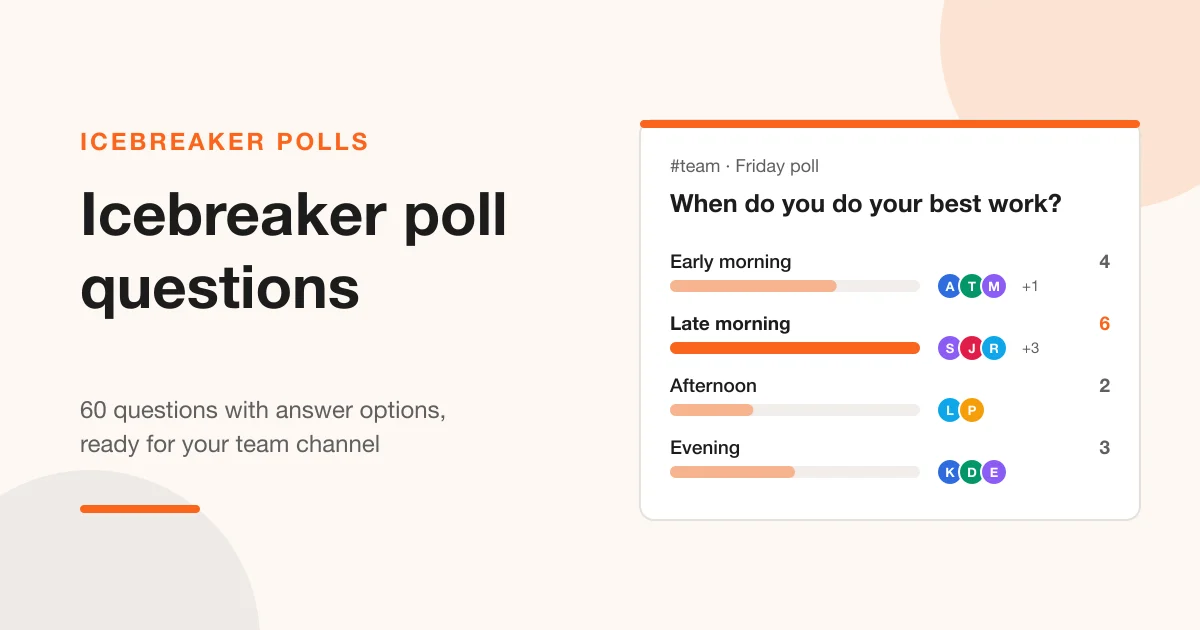
- When do you do your best work? (Early morning / Late morning / Afternoon / Evening / It changes every day)
- Your ideal meeting length? (15 minutes / 25 minutes / 45 minutes / An hour, if it's a good one / No meeting, send me a doc)
- How do you like to get feedback? (In writing / On a call / Face to face / Right away, however it comes)
- What does your desk look like right now? (Spotless / Organized chaos / Just chaos / What desk? I'm on the sofa)
- How many browser tabs do you have open? (Fewer than 5 / 5 to 15 / 16 to 40 / I'd rather not count)
- What do you listen to while you focus? (Silence / Instrumental or lo-fi / Podcasts / Loud music / Whatever's on in the background)
- Your notification settings? (Everything on / Mentions only / Off when I'm focusing / What notifications?)
- Which day do you protect for deep work? (Monday / Tuesday / Wednesday / Thursday / Friday)
- Where does your to-do list live? (A notebook / A notes app / A project tool / Sticky notes / In my head)
- Which emoji do you use most at work? (🙏 / 👀 / 😂 / ✅ / 🔥)
Question 3 is the one to remember. If most of your team prefers feedback in writing, that's worth knowing before the next round of reviews.
Food and drink polls
Food is the safest icebreaker topic there is, and the results come in handy the next time someone orders lunch for the team.
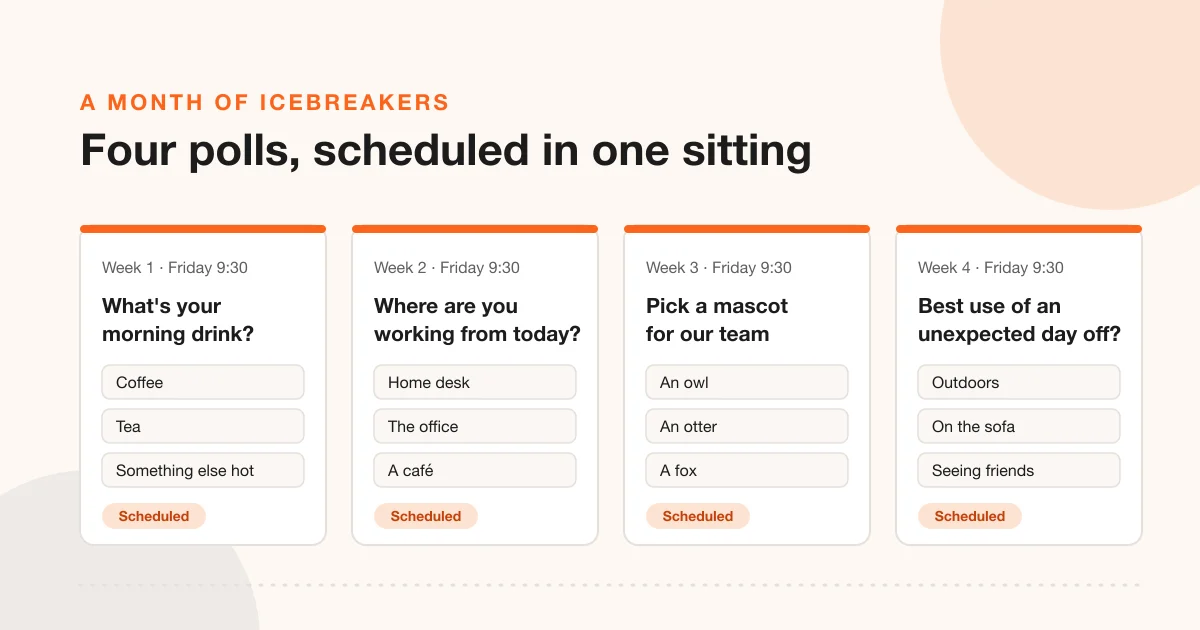
- What's your morning drink? (Coffee / Tea / Something else hot / Water and willpower)
- Best office snack? (Fruit / Crisps / Chocolate / Nuts / Whatever someone brought in)
- Pineapple on pizza? (Yes, always / Now and then / Never / I don't eat pizza)
- Do you eat lunch at your desk? (Most days / Sometimes / Never, I take a proper break)
- Breakfast for dinner? (Love it / Fine once in a while / No thanks)
- If the team ordered lunch today, what would you pick? (Pizza / Sushi / Tacos / Salad / Curry)
- How do you take your coffee? (Black / With milk / Something with foam / I don't drink coffee)
- Best cake for a team celebration? (Chocolate / Carrot / Cheesecake / Lemon / Ice cream instead)
Remote and hybrid work polls
Remote teams miss the small talk that happens on the way to the kitchen. These questions give people a glimpse of each other's days, and often a photo or two in the thread.
- Where are you working from today? (Home desk / Kitchen table / The office / A café / Somewhere unusual, photo please)
- Camera on for internal calls? (Always / Depends on the meeting / Rather not)
- What replaced your commute? (A morning walk / A coffee ritual / Exercise / Straight to the laptop)
- Who's your coworker most days? (A dog / A cat / Plants / A partner or housemate / Blissful silence)
- Your remote-work essential? (A good chair / A second screen / Headphones / Decent light / Snacks within reach)
- What's on your feet right now? (Slippers / Shoes / Socks / Nothing)
- What's behind you on video calls? (The real room / A blur / A bookshelf / A virtual background / Camera's off)
- How do you end your workday? (Close the laptop and walk away / Write tomorrow's list / Exercise / Badly, I keep checking)
Question 26 can open a useful conversation about switching off, as long as nobody turns it into a lecture.
Just-for-fun and hypothetical polls
These have no practical value whatsoever, which is exactly why they work on a Friday.
- Which superpower would help most at work? (Teleportation / Reading minds / Pausing time / Speaking every language / Never needing sleep)
- The team trip is booked. Where are we going? (The beach / The mountains / A big city / The countryside / Somewhere none of us has been)
- Besides Slack, you can keep one app for a week. Which one? (Email / Calendar / Maps / Music / Camera)
- You can visit one period of history for a day. Which? (Ancient Rome / The Middle Ages / The 1920s / The 1980s / The future)
- Dream office pet? (A dog / A cat / A fish tank / A parrot / A plant, it's less work)
- Your hidden talent is in... (Music / Sports / Cooking / Crafts / Keeping it hidden)
- Which chore would you happily give up forever? (Ironing / Washing up / Grocery shopping / Making the bed)
- Your role in a zombie film? (The leader / The medic / The builder / The scout / First to go)
- Pick a mascot for our team: (An owl / An otter / A fox / A tortoise / A goat)
- Best use of an unexpected day off? (Outdoors / On the sofa / Catching up on chores / Seeing friends / Learning something new)
For question 35, run the poll and then actually use the winner. A mascot emoji in the channel name or a custom emoji is a small thing that teams tend to grow fond of.
Getting-to-know-you polls for new teams
Use these in the first weeks of a new team, after a reorganization, or when two teams merge. They help people place each other without anyone having to introduce themselves to a silent call.
- How long have you been at the company? (Less than a month / Up to a year / 1 to 3 years / More than 3 years)
- Where in the world are you? (The Americas / Europe / Africa / Asia / Oceania)
- Morning person or night owl? (Morning person / Night owl / Neither / Depends on the deadline)
- How did you get into this line of work? (I studied for it / I fell into it / I changed careers / Still working that out)
- At work, are you more of an introvert or an extrovert? (Introvert / Extrovert / Somewhere in between / Depends on the coffee)
- What would you like to learn from someone on this team? (A tool we use / Presenting / Writing / Working with data / Something outside work)
- Best way to reach you? (Slack DM / A mention in the thread / A quick call / Email)
- What would you like to see more of in this channel? (Wins / Photos / Recommendations / Questions / Jokes)
Question 42 is a good one to follow up on. If three people want to learn the same tool and one person knows it well, you've found the topic for a short internal session.
New joiners also settle in faster when they talk to people one-to-one. Our list of coffee chat questions works well for those first conversations.
Check-in polls to open a meeting
A quick check-in at the start of a weekly meeting tells the facilitator how the room is doing before the agenda starts. Keep them playful so nobody feels they're filing a status report.
- How's your battery today? (Full / Half / Low / Running on coffee)
- What's the weather like inside your head? (Sunny / Partly cloudy / Foggy / Stormy / A rainbow after rain)
- The week so far, in one word? (Smooth / Busy / Messy / Quiet / Too early to tell)
- Your workload this week feels... (Light / Just right / Heavy / Underwater)
- What would make today a good day? (Finishing something / A quiet afternoon / A good conversation / Leaving on time)
- Pick an emoji for your Monday: (☀️ / ☕ / 😴 / 🚀 / 🌧️)
Question 48 can raise a real issue. If several people pick "Underwater", follow up privately after the meeting rather than in front of the group. If you want to track workload over time, a regular anonymous pulse check is a better tool than an icebreaker.
Seasonal polls
A few for the end of the year, plus some that work in any season.
- What are your end-of-year plans? (Travelling / Staying home / Visiting family / Working through / Still deciding)
- The best part of holiday food is... (Something sweet / Something roasted / The leftovers the next day / Whatever a relative made)
- Favorite season? (Spring / Summer / Autumn / Winter)
- New year's resolutions? (I make them and keep them / I make them, sort of / I don't bother / I start in February)
- How should we celebrate the next team milestone? (Lunch together / Coffee or drinks / An early finish / A shout-out in Slack / Surprise us)
Open-ended icebreaker questions
Not every icebreaker needs options. These work as free-text questions, and with names shown they turn into a list of recommendations and stories the team can scroll through.
- What's something you've read, watched or listened to recently that you'd recommend?
- What was your first job?
- What's a small thing that made your week better?
- What's a skill you picked up outside work that helps you at work?
- What's the best piece of advice you've had at work?
Question 56 is a reliable favorite. Collect the answers once a quarter and you have a team reading and watching list.
When an icebreaker poll fits
Monday or Friday in the team channel. A weekly poll at the same time becomes a small ritual. Friday afternoon suits the fun questions; Monday morning suits the check-ins.
The first minutes of a meeting. Post the poll as people join and look at the results together once everyone's in. It fills the awkward "we're waiting for two more people" gap.
A new joiner's first week. Run two or three of the getting-to-know-you questions, so the new person learns about the team as the team learns about them.
After a team change. When two teams merge or a new manager arrives, light polls help people get a feel for each other before the harder conversations about how the team will work.
A quiet channel. If a remote team's channel has become a place for announcements only, a weekly poll is often enough to bring the chatter back. Our list of employee engagement games has more ideas when you want to go further.
Running a weekly icebreaker poll in Slack
A poll posted in the channel where the team already talks gets far more answers than a link to a form. With Polls & Surveys, a weekly icebreaker takes a couple of minutes to set up:
-
Create the poll. Type
/pollin the team channel, paste a question from the list above and add its options. The free plan allows up to five options per question, which is why every list here stops at five. -
Show who answered. Leave the poll attributed rather than anonymous and set voter names to "Show all voters", so the message lists the people behind each option. Keep results live, so the split appears as answers come in.
-
Queue a month at once. Create four polls in one sitting and use "Schedule for later" to set each one for a different Friday morning. A recurring series repeats the same question every time, which suits a standing check-in like "How's your battery today?" and not a rotating icebreaker.
-
Close it at the end of the day. Set the poll to close at a date and time so the result becomes a snapshot the team can refer back to.
-
Skip the @channel. A weekly icebreaker doesn't need to ping everyone. People will learn when it appears.
People answer in a short form that opens from the poll message, and they can change their answer while the poll is open. Open-ended questions like 56 to 60 work as free-text questions in the same way.
If one person always ends up writing the questions, share the job. Our Round-robin Rotation app can announce in Slack whose turn it is to pick this week's poll, so it doesn't depend on someone remembering. New to polls in Slack altogether? How to create a poll in Slack compares the options, from emoji reactions to apps.
Turning a poll into a conversation
The poll is only half the icebreaker. The other half happens in the thread.
Post the result with a line of your own: "Six night owls and one person who works best at 5 a.m. Who are you, and why?" A specific, slightly teasing question gets replies where "Thoughts?" gets silence.
Reply to the people who chose "Something else". They picked it because they had something to say.
Use what you learn. If the lunch poll says tacos, order tacos at the next team lunch. If most people prefer feedback in writing, mention it when you plan reviews. Teams keep answering polls when the answers lead somewhere, even small places.
And don't worry when a poll falls flat. Some weeks four people answer and nobody comments. Next week's question will land better.
Topics to leave out
Icebreakers should be easy for everyone to answer in front of colleagues. Leave out questions about:
- politics, religion and other beliefs;
- money, salaries and what people own;
- health, bodies, weight and diets;
- relationships, family plans and private life;
- drinking, where one answer is the "fun" one;
- age, where options like "Which decade were you born in?" put people on the spot.
Also leave out anything with an obviously wrong answer, and anything that only works for people with a certain lifestyle. "Where did you go on holiday this year?" is lovely for some and awkward for others; "Beach or mountains?" includes everyone.
Finally, keep it optional. Nobody should be chased for skipping the pineapple poll.
Frequently asked questions
What makes a good icebreaker poll question?
A good icebreaker poll can be answered in a few seconds, has three to five options that are all reasonable answers, and leaves room for a story in the thread. Light topics like work habits, food, remote work setups and harmless hypotheticals work best.
How often should you post an icebreaker poll at work?
Once a week is enough for most teams. A regular slot, such as Friday morning or the first minutes of a weekly meeting, turns it into a small ritual people look forward to instead of another notification.
Should icebreaker polls be anonymous?
Usually not. The point of an icebreaker is to learn something about each other, so showing who picked what is what starts the conversation. Keep anonymity for check-ins about workload or mood, where people may want privacy.
How many answer options should an icebreaker poll have?
Three to five. Fewer than three makes the result predictable, and more than five slows people down. Adding a "Something else, tell us in the thread" option gives everyone a way to answer and often brings out the best replies.
Related articles
Written by
Keep reading


 How to Run an Anonymous Poll in Slack
Nov 24, 2026